Showing posts with label Maliki. Show all posts

Friday, January 3, 2014

The Political Face of Sectarian Hatred in the Middle East

Yesterday's bombing in Beirut illustrates the primordial influence of sectarian hatred in shaping Middle Eastern politics dynamics. As I noted on Monday, the Lebanese Hizballah is struggling to contain the wave of Sunni extremist violence that's directed against it. Regarding this sectarian anger, it's clear that there have been two separate counter-responses to Nasrallah's intervention in Syria. On one side, the March 14 bloc is trying to weaken Hizballah's political influence at the governing level. Supported by the Saudis in the form of new aid to the Lebanese Army, Siniora and Hariri are pushing for Hizballah's separation from any new cabinet. Conversely, motivated by their fanatical ideology, Salafi extremist groups are also seeking to weaken Hizballah. However, for these groups, the chosen mechanism of political activity is significant violence. What's clear is that sectarianism is now front and center in Lebanese politics (Martin Chulov gives a good reporting primer on Hizballah's role in this evolving dynamic).

But it isn't just Lebanon. If interested, here are some of my thoughts on the challenge of sectarianism in terms of...
  • Iraq (with latest news on Anbar here)
  • Lebanon (in relation to the Syrian Civil War)
  • Somalia (in terms of internal tensions within terrorist groups) 
  • How it leads people into terrorism/helps sustain terrorist groups

Monday, December 9, 2013

Analysis - Latest developments with Hizballah, Iraq and Ukraine

1) The Lebanese Hizballah appears to have lost another leader. Whoever was responsible for Lakkis's death last week, it's obvious that hostile pressure on the group is growing. With Hizballah now fully invested in Assad's survival, sectarian reactions to that strategy are also growing in intensity - hence the less of three senior leaders in as many weeks. In basic terms, Hizballah's political adversaries are taking advantage from the group's associated guilt for incidents like this one. As I've written before, Hizballah is suffering from an identity crisis of serious proportions. Devoid of a cross-sectarian base of sympathy, the organization's carefully constructed 'anti-oppression' narrative is being rendered for the lie that it is. Whatever happens with Assad, in Lebanon and beyond, Hizballah's strategic choices will leave them increasingly vulnerable. For a few of my related thoughts on Hizballah, please click (point five here), here and here.

2) ISIL continues to wreck havoc upon Iraq. In the absence of US Intelligence capabilities (please see my BBC debate on the NSA - takes a minute to load!) and amidst continuing political discord (please see my thoughts here), ISIL and its affiliates are once again endangering Iraq's stability. As the ISW's Jessica Lewis notes, ISIL has embraced a highly effective strategy of impatient resurgence. Again, it's important that we note the targeting methodology that ISIL embraces. As with their Salafi violent-extremist counterparts around the world, they are members of a death worshiping cult. Recognizing this truth, we should still be astute to the political grievances that allow groups like ISIL to prosper. Nevertheless, we must also grapple with the reality of a movement that sees cafes, markets, malls, roads and playgrounds as military targets.

3) The protests in Ukraine continue to grow. President Yanukovych has a problem. At a basic level, he has wagered against a long brewing discontent. Outraged by endemic corruption and Yanukovych's subservience to Putin's bullying/influence, many Ukrainians believe they're in a struggle for the very future of Ukraine. Quite understandably, these citizens have little interest in a future that abandons them to the ignominy of existence as a buffer state for Putin's Russia. While it's true that Ukraine is far from unified in its support for a pro-west future, younger Ukrainians are firmly ensconced with the pro-EU/US crowd. The trend lines are clear. Still, there are US policies that could help catalyze this process. Recognizing Ukraine's deep vulnerability to Russian energy blackmail, the US should urgently begin to provide an alternate source of energy to Eastern European states. By loosening regulations on US companies, exports of US Liquefied Natural Gas exports could begin in earnest. That alternate supply portfolio would enable Ukrainians to break free from their present headlock-like relationship with Russia. For some of my thoughts on Putin, please click here and here.

Other related writings can be found here.

Saturday, January 26, 2013

Jindal on GOP, Iraq strife, Syria, US in Mali, North Korea

A few issues today.

1) BOBBY JINDAL has said that the GOP needs to stop being stupid. He's right. But unfortunately, the problem goes far deeper than defective PR messaging and the occasional rape remark. The hard truth is that the GOP is disconnected from far too many Americans. Jindal was wrong to pretend that a simple turn of phrase will alleviate this condition of political dysfunction. Instead, conservatives need real, substantial Republican evolution. Evolution that doesn't dilute conservatism, but re-frames and re-energizes conservatism for the 21st century. We need a message that connects with inner city Americans. We need to forge a social conservatism that serves society. We need to build broad coalitions. And most certainly, WE NEED a party valuing of intellectual curiosity, rather than condemning of debate as subversion and treason. If conservatives don't address these problems, we will keep loosing elections. It's not my opinion, it's the 21st century.

Side note- If Republicans select credible candidates, the GOP can re-take the Senate in 2014.

2) IRAQ is not looking good. Five Sunni protesters were killed by government forces in Fallujah yesterday. Now the head of the Anbar Awakening Council (which was critical in helping the US Military restrain Al Qa'ida in Iraq) has threatened insurrection against government forces in Iraq's huge western province. It's important to understand that this situation is not the product of a single incident. For the past couple of years, tensions between the Shia dominated Iraqi Government and Iraqi Sunnis have steadily increased. On the one hand, the Iraqi Prime Minister, Maliki, fears a return to a Sunni dominated autocracy like that of Saddam Hussein. However, in order to guard against this, Maliki is making the terrible error of creating his own semi-autocracy. In doing so, he is playing into the hands of violent extremists like the Islamic State of Iraq coalition (an heir to Al Qa'ida in Iraq) which find power in Sunni fear. These terrorists are attempting to drive Iraq into a 2006 style sectarian civil war. And if that happens, you can guarantee that every agitator in Iraq (cue- al-Sadr)/the region (cue - Iran) will poke out their heads in order to make things even worse. To avoid this calamity, Maliki needs to engage in substantial cross-sectarian dialogue with his primary political rival- al-Iraqiya (the nationalist block). If Iraq returns to the abyss, the consequences will be catastrophic.

3) ASSAD's regime continues its downward spiral towards defeat. Following the rebels capture of Taftanaz, heavy fighting is now underway in the south-west Damascus suburb of Darayya, about two miles from Damascus city center (check google maps to see the proximity). As Nicholas Blanford's notes, the regime and its allies are investing all their resources in this last gasp battle. As a further example of the regime's endangerment, Iran is loudly trying to deter western intervention by issuing threats of a counter-response. I believe that as the rebels begin to encroach on central Damascus, the psychological pressure on the regime will cause an irreversible crumble in its power- those who can flee will do so (I expect Assad among them), those who cannot flee will try and hide. Only the extreme hardliners will remain and they will be defeated.

4) CONCERNING MALI, the French Government is now requesting major support from the US. They need our refueling assets, our logistical transport capabilities and our ISTAR resources. They need these things because for many years they have elected not to spend on these crucial assets. The French (as with their EU partners) believe it is preferable to have American taxpayers carry the weight of international security. I have to be honest, this infuriates me. European governments love to claim that they are modern servants of the enlightenment - spending on social welfare instead of on an effective military capability. During peacetime, Europeans criticize the US for our military expenditures. But without us, they are impotent. This is the false moralism of EU defense policy. Every time that military force is applied, the gaping holes in European military power become apparent. We should provide France with the support that they need, but the French must carry the cost (probably wishful thinking on my part) and President Obama should make an open statement condemning European hypocrisy on defense issues/spending (definitely wishful thinking).

5) NORTH KOREA is threatening a further nuclear test and evidence suggests that this threat is more than rhetoric. While the North Koreans are steadily improving their ICBM capability, we already know that they have an albeit basic nuclear weapons capability. To be honest, while the North Koreans are loud, aggressive and seemingly unpredictable, their unpredictability has predictable contours. In essence, North Korea's foreign policy is similar to the actions of a young child. When a child wants attention or gifts, they cry. When North Korea wants attention or gifts (economic aid), it threatens war. True, the North Koreans sometimes take major action, most recently sinking a South Korean ship in 2010. But it's also true that whether headed by il-Sung, Jong-il or Jong-un, the North Korean regime resides on a foundation of luxury and patronage. It's leaders don't want to die. For all their threats, the North Koreans are cognizant that war with the US would be an act of suicide. With American resolve and strength, North Korea can be deterred.

Thursday, January 3, 2013

Hezbollah scared, Arabs annoying posh London, Bombing in Iraq, Israel West Bank operation, Chicago violence

1) Hizballah is freaking out because their buddy Assad is screwed. By allying themselves with his regime, Hizballah is suffering serious damage to their brand. IE - The group is suffering from a profound degradation of their carefully cultivated (albeit false) image as a cross-sectarian liberation force. Nasrallah understands that when Assad falls, Hizballah will not only have lost a key ally, by supporting his brutal crackdown, the group will be politically weakened in Lebanon and beyond. I expect that Hizballah will attempt to increase tensions with Israel in 2013, in an attempt to reconstruct their 'defender' image. Regardless, in the long term I believe that the organization will share Assad's fate. By using murder and intimidation as primary political tools and by supporting authoritarians who deny basic freedoms to their people, Hizballah will find it increasingly difficult to win legitimacy and corresponding popular support. True, Hizballah retains strong sympathy among poor Lebanese Shia, but in order to maintain its considerable power base the group must attract a wider base of interest.

2) Posh Londoners are upset because Arab playboys are driving super cars late at night. Although the noise might be annoying, I'm going to venture that these visitors make a rather positive contribution to the UK's economy. But I guess its a question of priorities - posh Londoners getting relaxing sleep, or poorer Londoners having jobs (in the clubs, bars, restaurants and stores that the playboys visit)... Ah the complexities of the British class system!

3) Around twenty people were killed in an explosion in Iraq today. The cause - a terrorist attack that was probably conducted by the Islamic State of Iraq. This organization is attempting to ignite sectarian war in the country. An ISI strategy that has elevated in momentum over the past year. As I argued back in July, the US must provide the Iraqi Government with the intelligence support that it may need in order to confront the terrorists. We must not allow extremists to erase the security successes that our military worked so hard to achieve in Iraq. Having said this, we also need to pressure PM Maliki to build cross-sectarian consensus in his country.

4) Chicago is suffering the impact of a terrible gang war. As in many American inner cities, the Democrats have failed Chicago. Conservatives can and should re-engage with these citizens to offer solutions.

5) Unless the Israelis were A) seriously concerned about leaks, or B) had imminent actionable intelligence, their raid on a West Bank apartment was a serious error. These kind of actions make President Abbas look weak and delegitimize his leadership in the eyes of Palestinian voters. The Israelis should be working to empower Abbas and isolate HAMAS, not vice versa.


Monday, July 23, 2012

Terrorist Attacks in Iraq

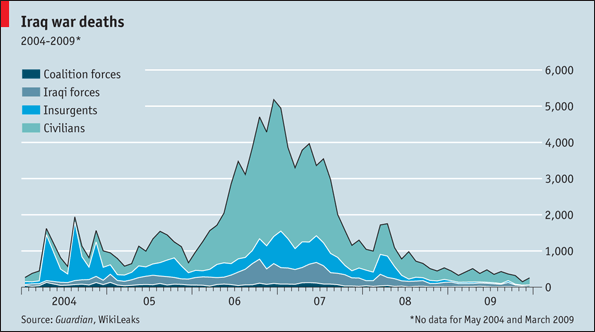
Today's terrorist attacks against the people of Iraq are a reminder that the fight for stability in that country is not over. The attacks also illustrate the degree to which the Islamist insurgency (who are responsible for these attacks) has always (at least in strategic terms) been divorced from the nationalist rooted insurgency (which sought the withdrawal of Coalition forces from Iraq). Much of the post-war violence in Iraq in the 2006- period onwards was due to the Islamist groups rather than Nationalist.

From my perspective, the current terrorist attacks are indicative of a resurgent Islamic State of Iraq (Sunni terrorist alliance). The group has a central two-fold focus- 1) To re-instigate a civil war between Iraqi Sunnis and Shia. 2) To use the ensuing chaos in order to form a Sunni caliphate in at least part of Iraq.

While Iraqi security forces have improved dramatically over the past few years, they still require extensive support in terms of logistics and intelligence. The United States must stand ready to provide this assistance where more is needed. We must also continue to pressure Iraqi Parliamentarians to find compromise with each other wherever possible. In addition, Prime Minister Maliki (Dawa) still retains far too much executive control over elite security units and too little interest in reconciliation with the Iraqiya block. The United States must work hard to address this problem.

Monday, December 26, 2011

Iraq Crisis

Iraq is on the edge. Maliki must try and a find a way to get al-Iraqiya back into the political process. Al-Sadr is attempting to manipulate the space that this situation is providing. Iraq needs a cross-sectarian, stable government that respects all of it's citizens. This will take time. But wilfully ignoring Iraq's sunnis will only fuel the extremism that Iran and Al Qa'ida seek to enshrine.

Thursday, December 22, 2011

Baghdad Attacks

The attacks in Baghdad are a reminder of the work still to be done in securing that country. It is likely that the Islamic State of Iraq (Al Qa'ida in Iraq spin off) are responsible. The degree of systematic, co-ordinated violence is a hallmark of their operational strategy. The Iraqi government must pursue reconciliation alongside security operations. If Maliki does otherwise, he will risk further separation between Iraq's various sectarian groups. An outcome which is almost certainly the political intention of today's terrible attacks and an outcome that will risk a return to the violence of 2006.

Friday, June 3, 2011

1) Yemen is on the verge of becoming a failed state. AQAP will be loving the current situation. Yemen's water problems are a major, major issue.

2) The House of Reps is right to be angry with Obama on Libya. He has ignored them, ignored the war powers resolution and ignored the need for the development and implementation of a clear, defined and effective mission plan. It is surprising that Obama who was supposedly going to be a more consensual and less executive focused leader has been so willing to ignore congress.

3) The US must put more pressure on the Maliki government to treat protesters with fairness and dignity.

4) Weiner better get some message control going..

5) The real problem in reconstruction efforts for Afghanistan is a lack of collaboration between different government agencies combined with a lack of oversight and planning.

6) Really can't see how this is any different to Obama's plan. Obviously Obama also knows that Israel cannot negotiate on the issue of its jewish statehood.

7) Once again.. on the Babar Ahmad trial the CPS brought a case to trial that had no merit.


8) Some good news. As I wrote in the guardian, we are lucky to have these citizens.