Following an attack by apparent supporters, members of various Iraqi terrorist groups (including Al Qa'ida in Iraq) have escaped from prisons in that country. The number of escapees is estimated to be in the hundreds. Many of these prisoners are ideologically intransigent killers. This attack follows a similar incident in late September 2012, when members of the Islamic State of Iraq (the effective successor to Al Qa'ida in Iraq) attacked another prison.
This jail break comes at a disastrous time for the Iraqi people. As I wrote for The Atlantic, Iraq's security situation is rapidly deteriorating. From all sides, violent extremists are seeking to rip sectarian fissures into the Iraqi population. While Sunday evening's rampage is only the latest in a string of horrific recent incidents (see video below), it speaks to a serious problem - the growing capability of increasingly audacious terrorists. By attacking such a high profile, fortified target as Abu Ghraib prison, these insurgents are illustrating their ability to challenge the governing power of the Iraqi state. In the context of the Syrian civil war and heightening instability in Lebanon, the bloodshed in Iraq represents a profound humanitarian and strategic threat. As such, the Obama Administration must utilize all their (albeit limited) influence to bring Iraqi politicians into dialogue and if necessary, to render increased US Military/Intelligence support to Iraqi security forces.
Around the world, the greatest enemy of Muslim citizens is Islamist extremism. Today, in Pakistan, Sunni Islamists detonated a bomb in a market that is popular with Shia Pakistani families. Many are dead. These civilians were brutally murdered because of their beliefs. Just over a month ago, over 100 civilians were killed in a similar attack. But it isn't just Afghanistan and Pakistan which are suffering. In Iraq for example, alongside frequent bombings, assassinations of senior civil servants and politicians have also become more common. The main perpetrator of these attacks is the Islamic State of Iraq, an heir to Al Qa'ida in Iraq, and a group which seeks to return the country back into the bloody clutches of sectarian civil war. A time of death characterized by the torture of children, hostages killed in fire pits, the use of electric drills as implements of torture and the morally foul disinterest of too many senior American politicians.
Recognizing this brutality is crucial. But it's also equally vital that Islamic societies face up to the evil which festers inside them. For far too long, warped terrorists have found quiet excuse for the atrocities which they commit. That has to change. While effective counter-terrorism partly requires the application of force, the construction of a new social tolerance is key. In essence, the growth of a political discourse that alleviates concerns regarding cross-sectarian participation in governing society (see growing protests in Iraq). During the period between 2003-2006 in Iraq, a significant violence enabler was the US strategic failure to separate intransigent ideological extremists from broader social discontentment. When the strategy changed, violence reduced dramatically. The lesson is this - until extremists are loudly discredited from all sides of a society (or ended), they find breaches in which to take root and foundations to manipulate the broader dissatisfaction of others.
Finally, we must also condemn bigotry in all its forms. Nonetheless, because of nuclear proliferation, Islamist sectarian currents pose an exceptional threat to international security.
On a related note, here's a link page for my other terrorism related writings.
In my view, Jones's argument is weak; indicative of the author's poor understanding of international affairs and his embedded anti-american sentiment. Below, I have responded to the major arguments that Jones makes.
After all, it was difficult to defend an administration packed with such repulsive characters, like Dick Cheney and Donald Rumsfeld, whose attitude towards the rest of the world amounted to thuggish contempt.
Cheney and Rumsfeld may be controversial characters (I often disagree with their positions), but I reject the notion that they are 'repulsive'. From their perspective, the US faced critical national security challenges that required robust policy responses. I respect that both men did what they thought was right for the United States. Jones seems to think that because Cheney and Rumsfeld disagreed with his European leftist world view, they were beyond reproach. He is wrong.
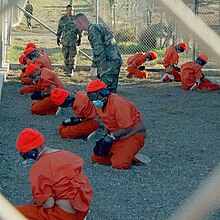
Many will shudder remembering that dark era: the naked human pyramids accompanied by grinning US service personnel in Abu Ghraib; the orange-suited prisoners in Guantanamo, kneeling in submission at the feet of US soldiers; the murderous assault on the Iraqi city of Fallujah.
I take issue with everything here. In response to the despicable abuses at Abu Ghraib, the US Military rightly punished those responsible. The actions of these personnel were an aberration from the fine conduct that the US armed forces exemplify 99% of the time. It is disgusting that Jones asserts that Abu Ghraib was a deliberate action on the part of the US Government.
On Guantanamo, the photo that Jones refers to was taken in January 2002, just after the first prisoners had arrived. The photo shows nothing more than the detainees sitting in a control position. However, for those on the hard-left like Jones, the photo serves a natural metaphor for their inherent disgust towards the notion of military justice. I always find it amusing that people like Jones have no concerns about the military justice system when it is used against military personnel, but get incredibly upset when it is used against terrorists.
Fallujah - Jones's most idiotic point. Jones evidently has absolutely no understanding of military operations in urban environments. They are always bloody, always destructive and always unpleasant. However, prior to its Fallujah operation, the US Military took great effort to evacuate the city of civilians. As a further indication of the US Military's desire to prevent civilian loss of life during the operation, only 10% of requested (pre-ground force entry) air strikes were authorized. Pre-November 2004, Fallujah was the primary base of operations for Al Qa'ida in Iraq. It was the place where car bombs were constructed to be used to murder innocent Iraqis, it was the city where hostages were held, tortured and executed. It was the physical and ideational home of those who wanted to destroy Iraq. It was where men like Janabi murdered Iraqi patriots who simply wanted to bring justice to their communities. Put simply, the US had no alternative but to take Fallujah. Had we not, thousands more Iraqis would have died at the hands of the insurgents and Iraq's stability and security (already endangered) would have been placed in much greater jeopardy. (See one example of Al Qa'ida in Iraq actions).
This week, the UN's Special Rapporteur on Human Rights and Counter-Terrorism, Ben Emmerson QC, demanded that the US allow independent investigation over its use of unmanned drones, or the UN would be forced to step in.
Good luck UN. The US is at war. We have the right to defend our citizens. I wonder if like me, Jones visualizes this when he writes that the UN will be 'forced to step in'. Note- I am simply arguing that the UN is an impotent joke that serves dictators rather than democracy. I am not endorsing feeding UN officials to sharks.
In one such attack [predator drone] in North Waziristan in 2009, several villagers died in an attempt to rescue victims of a previous strike.
It might be unpleasant, but the US must address those who threaten us. It would be militarily absurd to allow our enemies to be withdrawn from the battlefield, to then be able to plot against us once again.
According to Pakistan's US Ambassador, Sherry Rehman, the drone war "radicalises foot soldiers, tribes and entire villages in our region". After the latest strike this week, Pakistan's foreign ministry said the attacks were "a violation of its sovereignty and territorial integrity and are in contravention of international law". Its Parliament has passed a resolution condemning the drone war.
I have little doubt that the drone strikes help cause the radicalization of some Pakistanis. This is regrettable. However, in my opinion the US has no choice but to utilize the drones. Extremist groups in Pakistan pose a substantial threat to the security of the United States. Pakistan may complain, but Pakistan is in bed with these terrorists. Perhaps if the Pakistani government/military got tougher on extremists, Pakistan would have a logical argument with which to persuade the US to end the drone program.
It [drone program] is armed aggression by the Obama administration, pure and simple.
BS. It is self-defense justified by moral and strategic necessity.
Two months ago, former US President Jimmy Carter described drone attacks as a "widespread abuse of human rights" which "abets our enemies and alienates our friends". He's not wrong: the Pew Research Center found just 7 per cent of Pakistanis had a positive view of Obama, the same percentage as Bush had just before he left office.
You don't fight a war based on opinion polls.
[Re-Afghanistan]US involvement in a senseless, unwinnable war in the country – ruled by a weak, corrupt government that stole the 2009 presidential election with ballot stuffing, intimidation and fraud – continues.
Under Obama, the US role in the Middle East remains as cynically wedded to strategic self-interest as ever. Despotic tyrannies like Saudi Arabia are armed to the teeth: in 2010, the US signed an arms deal with the regime worth $60bn, the biggest in US history. Obama has resumed sales of military equipment to Bahrain's dictatorship as it brutally crushes protesters struggling for democracy. Last year, Saudi Arabia invaded Bahrain with tacit US support. And even when the US-backed Mubarak dictatorship was on the ropes in Egypt, Obama's administration remained a cheerleader, with Secretary of State Hillary Clinton arguing that the "Egyptian Government is stable and is looking for ways to respond to the legitimate needs and interests of the Egyptian people".
I actually broadly agree with Jones here. The US should have withdrawn support for Mubarak far earlier - he had become a despot beyond redemption. The US must also exert pressure on Saudi Arabia to improve human rights and democracy conditions. Unfortunately as I have previously argued, until we get rid of our oil addiction, America will remain on the Saudi leash. My concern with Jones is that he doesn't realize how hypocritical he is being when he criticizes US pro-democracy action in Afghanistan and Iraq, but simultaneously demands pro-democracy action everywhere else.
Coupled with the US's ongoing failure to pressure Israel into accepting a just peace with the Palestinians, no wonder there is rising global anger at Obama.
Peace will not come until the Israelis and Palestinians desire a lasting settlement. Jones plays the typical card of blaming Israel, even though the Israeli peace proposals in 2000 and 2008 - rejected by the Palestinian leadership - were bold and generous. I am hopeful that Netanyahu will be increasingly able to isolate extremists in his coalition who oppose peace. I also hope that HAMAS inability to improve the lives of Palestinians in Gaza will lead to their collapse (sadly I doubt HAMAS cares much for democratic tradition).
The US share of global economic output was nearly a quarter in 1991; today, it represents less than a fifth. The financial crash has accelerated the ongoing drain in US economic power to the East. Latin America, regarded as the US's backyard since the 1823 Monroe Doctrine claimed it for the US sphere of influence, is now dominated by governments demanding a break from the free-market Washington Consensus.
China will face major problems as it seeks to deal with a large population who lack freedom and economic mobility. With strong leadership, the US can retain its position as the world's foremost power. Jones comments on S/C America are hilarious. He neglects to mention that the major economic powerhouses of Brazil and Colombia have rejected the wacko Chavez aligned movements which are falling apart at the seams. I always find it staggering that the European left worship men like Chavez and Castro. Chavez has destroyed Venezuela's economy while supporting a band of murdering rapists in Colombia. Castro rules over a country in which only 5% of the population have cars and from which many Cubans risk crossing shark infested waters to escape the 'communist paradise'. For Jones to embrace these regimes is both morally foul and intellectually bankrupt.
the Iraq war not only undermined US military prestige and invincibility, it perversely boosted Iran's power in the Middle East.
The hard left love using this line, yet Maliki (albeit too autocratic) is by no means an Iranian stooge. The Iraqi people determine their own future now. Jones apparently mourns the 'safe hands' of Saddam Hussein.
With the last remaining superpower at its weakest since World War II, there is an unmissable opening to argue for a more equal and just world order, restricting the ability of Great Powers to throw their weight around. And a word of warning: if we don't seize this opportunity now, one superpower will simply be replaced by another – and our world will be as unequal and unjust as ever.
Since the end of the Second World War, America has preserved international security and freedom. This has come at significant expense in American treasure and at a high human cost to the American people. Without the US, the world would be at the mercy of violent extremists. The security of the seas (crucial for international trade) would be endangered and the ambitions of autocrats from Russia to China to Venezuela would be unleashed. I have no comprehension of what kind of world Jones wants. Presumably he is one of those leftists who subscribe to the incomprehensible notion that the UN can preserve international order. Just look at Rwanda, Kosovo, Sudan, Afghanistan, Iraq, Libya and Syria to see the UN's 'peace' record. Perhaps Jones wants the Chinese to assume the mantle of global power? Again, that might not be so good for those in Asia or those around the world who wish to be free.
In the end, I suspect that there is a deeper motivation behind Jones's words. For Jones as for so many on the hard left, America is an obstacle to their (false) socialist utopia. They wish for a system in which power is centralised with an elite who know what is best for everyone else. Conversely, America believes in and stands for a system via which individuals hold power and enrich society, through communities built upon tangible mutual interests and ideals.
America is far from perfect, but a strong America is necessary for the security and freedom of people everywhere.
Today's terrorist attacks against the people of Iraq are a reminder that the fight for stability in that country is not over. The attacks also illustrate the degree to which the Islamist insurgency (who are responsible for these attacks) has always (at least in strategic terms) been divorced from the nationalist rooted insurgency (which sought the withdrawal of Coalition forces from Iraq). Much of the post-war violence in Iraq in the 2006- period onwards was due to the Islamist groups rather than Nationalist.
From my perspective, the current terrorist attacks are indicative of a resurgent Islamic State of Iraq (Sunni terrorist alliance). The group has a central two-fold focus- 1) To re-instigate a civil war between Iraqi Sunnis and Shia. 2) To use the ensuing chaos in order to form a Sunni caliphate in at least part of Iraq.
While Iraqi security forces have improved dramatically over the past few years, they still require extensive support in terms of logistics and intelligence. The United States must stand ready to provide this assistance where more is needed. We must also continue to pressure Iraqi Parliamentarians to find compromise with each other wherever possible. In addition, Prime Minister Maliki (Dawa) still retains far too much executive control over elite security units and too little interest in reconciliation with the Iraqiya block. The United States must work hard to address this problem.
Today's attacks in Iraq are very likely to be the work of Al Qa'ida in Iraq. The multiple actions included strikes against diners in restaurants, a school and a mosque. This is the nature of Sunni Salafist extremists - extraordinarily aggressive application of force in pursuit of a total war doctrinal strategy.* A strategy that in AQI's case, is rooted in the pursuit of the destruction of the Iraqi state via the propagation of genocidal levels of sectarian violence. The intention of today's attacks is thus to spark sectarian warfare among different communities of the Iraqi people (Shia areas were targeted), much like with AQI's intention in conducting the 2006 attack on the Golden Mosque. The current sectarian dysfunction in the Iraqi Govt is seen by AQI as an opportunity ripe for exploitation. Clearly also, it is important to note that the (post- Coalition withdrawal) absence of large scale counter-terrorism capabilities from the US/UK has allowed AQI space to re-constitute to a position where in they can effectively carry out large scale attacks such as today's. (US/UK counter-terrorist forces waged a highly effective attritional campaign against AQI during 2007/08/09 that effectively destroyed the group's senior and middle leadership).
Another point to note here is that the proximate position of Iraq to Syria/Iran means that instability in Iraq has profound consequences for the rest of the region. Amidst the ongoing Iranian nuclear crisis/Syrian uprising, reducing tensions in Iraq must be a priority for the US govt. Joe Biden has done some pretty good work on this recently. At the same time, Obama should ensure that the CIA station in Iraq has the support it needs (especially from the NSA) to be able to provide actionable intelligence to Iraqi security forces.
*- The current leader of AQI, Abu Dua, is true heir to Zarqawi.
"held religious courts to try local citizens charged with supporting the Iraqi government and coalition forces. He would kidnap individuals or entire families, accuse them, pronounce sentence and then publicly execute them."
People like Dua are a reflection of the irreconcilable element of a terrorist organisation.
These individuals can only be dealt with through capture/kill operations.