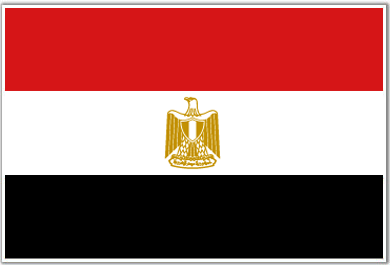
What occurred was a massacre (see El Amrani at The Arabist for his take on the possible motivations for the crackdown).
This wasn't a ''security'' operation, it was protest clearance from the school of brutal totalitarianism- via bulldozers and snipers. The Egyptian government decided that they were going to crush Morsi's supporters and they did just that.
Others are covering the specificEgyptian political angle, but I want to consider why American diplomacy was unable to foresee or restrain this human disaster. I think there are three key reasons.
Absent policy clarity/direction
From the very start of the 2011 Egyptian revolution, the US Government has been hesitant to adopt a clear policy in Egypt. After promising to support Egyptian democracy, President Obama then cut related aid. Only when Mubarak's fall became inevitable and the bloodshed intolerable, did Obama finally pressure Mubarak to fall from power. The Egyptian people asked for our support and they found our equivocation. In a similar vein, Secretary of State Kerry's remarkstoday were the first significant US condemnation of the Army since Morsi's removal from power a few weeks ago. We're still unwilling to commit to the basic premise of Egyptian democratic rights.
To Egyptians on all sides, the political essence of US policy is now viewed in largely the same manner- that the US Government lacks the courage and confidence to establish a clear policy and then support that agenda with action. In result, America's influence has withered and Egyptian political dynamics have run out ahead of us. At terrible cost. Instead of shaping Egypt's transition towards stable democracy, all too often, we've been chasing the metaphorical greyhound. This failure helps explain why the US is so mistrusted by Egyptians. In short, by attempting to hedge our bets, we've ended up burning our cards.
Absent moral courage
At its core, US foreign policy must reside upon certain non-negotiable values. These should include our unyielding support for democracy, civilian protection and the rule of law. If there's one thing that encompasses all these concerns, it's that America won't tolerate the use of violence against innocent protesters. The Egyptian government believed that we wouldn't stand in support of that belief. This evening, nearly 300 people are dead. Don't misconstrue me, I'm not saying that America should have supported Morsi against the Army (his tenure was hardly defined by adherence to democratic tradition). But because we've been willing to tolerate the Army's increasing brutality since Morsi's fall, we've played to the propaganda narrative of the hardliners who oppose us - the notion of an America without honor. The sad reality is that our gelatinous morality has born a terrible cost - the US Government has discredited itself in the eyes of the Egyptian people and has discredited American values in the eyes of the world.
Absent will to engage with political complexity
At the heart of American dysfunction in Egypt is our emotionally laden and logically deficient foreign policy discourse at home. Since 2011, most American politicians and commentators have sought to define Egypt's political crisis as a fight between existential forces of democracy (the Army/anti-Morsi protesters) and totalitarian Sunni Islamism (the Muslim Brotherhood). From both the American political right and political left, our policy debates have taken refuge in intransigent understandings that discourage foreign policy bi-partisanship on Egypt. We've entertained the myth of simple policy prescriptions - support the army/oppose the Brotherhood - an approach that was and remains fundamentally flawed. This has weakened the prospective power of our diplomats. Alongside a determined policy born of moral and strategic clarity, we also need influence with all Egypt's actors. Most of all, we need to reclaim American foreign policy to a position of intellectual endeavor. The politics of the Middle East and north Africa are not simple.
In the end, the political repercussions of today's events are likely to reverberate for years to come. Salafist extremists will be lavishing over the prospect of a new batch of disaffected recruits - individuals who thought protesting was a democratic right and paid for that belief in blood. This is a huge propaganda coup for theenemies of democracy. Yet, America can recover. We can rebuild our influence. If we use this tragedy to inject a new courage to our policy in Egypt - to propagate a policy centering around a mix of absolute values and flexible relationships, we can help Egyptians reach a better, more inclusive and decidedly more hopeful future.
On Saturday, co-ordinated car bombings killed over 50 people.
On Sunday, more than 60 civilians were killed as they gathered to celebrate the breaking of fast (the culmination of Ramadan).
Yesterday, terrorists attacked a cafe and playground, killing around 20 people.
Empowered by recent prison breaks and emboldened by a growing sense of political disenfranchisement in Sunni communities, Iraq's core Salafist Jihadi alliance (ISI/L) is pursuing a relentless campaign of terrorism. The intention of this campaign is clear - to attack communal, Shia dominated public gatherings... so as to maximize civilian casualties... fostering a pervasive condition of physical and psychological insecurity... forcing a overaggressive reaction against Sunnis by Iraq's Shia majority government... facilitating a descent into open sectarian civil war. As I argued in June, Iraq now stands on the precipice of civil war.
Unrestrained by any logical moral compass and intoxicated by the notion of serving a divine righteousness, these ideologues view extreme violence as a just and necessary tool. Of course, their understanding is patently absurd - in actuality, they're the worst enemies of Islam (incidentally, yesterday's playground attack took place in a town where US forces once helped build a school). But regardless of their moral delusion, their actions are threatening Iraq's existence.
In response, the Obama Administration must engage with the Iraqi government about the prospect of increased US Military/Intelligence support. Stan McChrystal's counter-terrorist campaign provides a powerful template for how small groups of individuals can contribute to significant improvements in civil security.
We also need to remember that this isn't a localized crisis. For a start, facing attacks on Syrian Kurds from ISI/L formations in Syria, the leaders of Iraq's Kurdish community are threateningto intervene in that country. In addition, under serious pressure, the Lebanese Hizballah are also likely to resort to greater violence.
Ultimately, the more sectarian frictions increase, the greater the bloodshed that will follow.
The west is far from immune to this crisis. In the longer term, this toxic blend of ideological totalitarianism and sectarian hatred will pose a severe threat to global security (see the looming impact of nuclear proliferation).
Note - links to my more recent comments on free speech - up to late 2015 - follow at the end of this post. Recent media acquisitions (like the purchase by Amazon CEO, Jeff Bezos, of The Washington Post), are rendering ultimate vindication to the Supreme Court's controversial Citizens United decision. It's now blindingly obvious that traditional distinctions between media vs corporate speech have all but evaporated. It's no longer plausible to argue that traditional media outlets deserve a specially protected status in the realm of free speech.
Nevertheless, opponents of Citizens United continue to offer explicit and implicit endorsements for 'privileged' media speech. This is absurd. To defend privileged speech is to argue that advocacy groups/corporations outside of an (inherently subjective) media identity do not deserve free speech. It's the ultimate incarnation of Orwell's warning - ''all animals are equal, but some animals are more equal than others.'' Whether driven by seeming business interests (Bezos - Washington Post), or personal interests (see John Henry's acquisition of The Boston Globe), where corporate/political owner sympathies are perceptibly apparent, the flowing social implication is evident - media speech is not as 'pure' as some would suggest.
In this sense, it's astonishing that many commentators see no hypocrisy in the flagrantly biased approach that they take towards media assessment (see Pitts here, then here). Consider the dichotomy of reaction that characterized Henry's Globe acquisition, and suggestions that the Koch brothers might purchase The Los Angeles Times. While Henry attracted very little scrutiny, rumors over the LA Times garnered widespread outrage. Indeed, half the LA Times newsroom apparently threatened to quit if the Koch purchase went ahead.
Of course, when one considers the facts objectively, the distance between Henry and the Koch brothers isn't obvious. For a start, much as he might frame his purchase as a personal endeavor, Henry has spent over $1 million supporting Democratic candidates. Suddenly, the Koch brothers have company in the land of political activism. This speaks to a certain truth - overtly liberal media acquisitions are ever apparent. For one example, take Facebook billionaire (and avowed liberal), Chris Hughes's 2012 purchase of The New Republic.
So we need to be honest. Ultimately, if we want historic media outlets to survive, politically accentuated purchases will probably be unavoidable. But this doesn't mean that we should be delusional to the modern media industry. As much as the Citizens United decision was unpopular, it was also logically inevitable. Why? Because to argue otherwise - that traditional media outlets have a special status in society - represents the height of arrogance. It's the embrace of a profoundly un-American system of tiered speech - one in which the wealthy can buy speech dominions while other corporate/NGO entities are restrained in silence.
As Justice Kennedy explained in his Citizens United opinion:
''The law before us is an outright ban, backed by criminal sanctions. [The law] makes it a felony for all corporations—including nonprofit advocacy corporations—either to expressly advocate the election or defeat of candidates or to broadcast electioneering communications within 30 days of a primary election and 60 days of a general election. Thus, the following acts would all be felonies under §441b: The Sierra Club runs an ad, within the crucial phase of 60 days before the general election, that exhorts the public to disapprove of a Congressman who favors logging in national forests; the National Rifle Association publishes a book urging the public to vote for the challenger because the incumbent U. S. Senator supports a handgun ban; and the American Civil Liberties Union creates a Web site telling the public to vote for a Presidential candidate in light of that candidate’s defense of free speech. These prohibitions are classic examples of censorship.''
If interested, below are some of my other writings on freedom of speech (from as recent as late 2016) -
The
Obama Administration should take those words literally. After years of
diplomatic failure, only a realistic approach can improve US-Iranian relations.
Yes,
Rouhani is likely to be an improvement on his inauspicious predecessor (a
clownish narcissist now locked in a desperate struggle for relevance). Iran’s new President has
promised to improve women’s rights and seek better relations with the west. If
nothing else, his tone is more conciliatory. These developments are, even if
only prospective, good.
Nonetheless,
enamored by the potential for change, many western commentators have
reacted with unrestrained elation. Rouhani’s election has made ‘’imaginable
what for years has been unimaginable.’’said Stephen Kinzer inThe Guardian.
In response, ‘’The Obama Administration should signal a shift in
style, substance and strategy’’declared Ali Vaez in the Christian Science Monitor.
Some went even further. In a particularly odd commentary for Al Jazeera,
the academics, Flynt and Hillary Leverett found that Iran now offers a ‘’concrete
expression’’ of Muslim democratic emancipation.
I think
not.
Rouhani might not be Ahmadinejad, but that certainly doesn’t make him an
Iranian Jefferson. After all, his existing human rights record isn’t exactly
stellar. During the student protests of July 1999, Rouhani embraced a gleeful
brutality - "From today’’ he warned, ‘’our
people shall witness how… we deal with these opportunists and riotous elements,
if they simply dare to show their faces." He wasn’t joking.
The students were crushed. It’s also been alleged that Rouhani played a key role in the use of
terrorism against Iranian dissidents living abroad.
More
concerning in the present however; the new President is a proud supporter both of Iran’s nuclear program and
of continued assistance to the Syrian dictator, Bashar al-Assad.
These
facts should lead us to a cautious conclusion – a pleasant tone means nothing
without substance.
Nowhere
is this more true than with regards to the Iranian nuclear crisis.
While some analysts believe that Iran's present condition of international isolation
and inflationmake a nuclear deal likely, I'm not so sure. To me, that argument resides upon an intrinsically western
conception of state interests; secular, populist and relative to the moment.
Yes, Iran’s leaders obviously care about economics. Unfortunately, they care
far more about joining the nuclear club. As I’ve argued before, the theocrats view nuclear power as the
existential guarantor for their ongoing revolutionary project. This
understanding explains why, again and again, we’ve seen nuclear negotiations rise in hope and
then collapse in failure. Put simply, for the Ayatollahs, compared to the
prospective feast of a nuclear dominion, western concessions are nothing. We
think we have cake, but we only have crumbs.
Playing
to our delusion, Iran adopts the foreign policy brother to Madoff’s Ponzi
scheme- a negotiating strategy that uses trickery to buy time
for nuclear advancement. The scam? Offer flirtations of peace, blame western
intransigence for a negotiating failure, then, a few months later, start all
over again. By allowing emotion to dominate our logic, we buy it every time.
Rouhani’s
arrival allows Iran to play the same game with a fresh face.
It
needn’t be this way. For all their bluster, Iran’s leaders understand that a military conflict with the United States
would be a disaster for their interests. If we grasped this – we could, alongside stronger sanctions, perhaps deter them into ending their nuclear program. Unfortunately,
emboldened by western impotence in Syria and Obama’s stuttering threats, American warnings bear little weight. For deterrence to be real it must first be believed.
There’s
another political component at stake here- Israeli patience with diplomacy is nearly exhausted.
Following
Rouhani’s election, Netanyahu again pressured the Obama Administration for tougher sanctions. I suspect that Israel’s Prime Minister fears Iran will use Rouhani the reformist to
evade future sanctions. Nearly a year
after Netanyahu’s ‘red line’ speech, it’s obvious that time is running out. In addition, though it's pure speculation on my part, Netanyahu's restoration of the Israeli-Palestinian peace process could indicate his desire to get President Obama 'on side' prior to an Israeli military attack on Iran.
Regardless, it's a
dangerous wager to assume that Netanyahu’s warnings are a bluff. Israel’s
security strategy resides upon Israel's regional supremacy of power. Where some cannot look
beyond the risks of military conflict, Israelis (and the Sunni Arab monarchies)
see a nuclear Iran as an intolerable threat.
In this
sense, if Rouhani's style is divorced from substance, his arrival will provide
little aid to the cause of peace. My related writing.
This incident reeks of Hizballah. As I argued earlier this week, the organization is facing major pressure both inside and outside Lebanon. Further, the group's modus operandi illustrates that they are in love with this form of calculating, semi-covert warfare. In addition, it takes serious capability to pull off something like this - intelligence planning, combat skill and political conviction (the Turkish Government isn't likely to be happy). Oh... and don't be so sure that those 'pilgrims' (see the BBC article) were actually pilgrims. My related links. Tomorrow, I'll be writing on Iran's new President.
I've written about foreign policy issues a lot over the past few days. I think it's time for something a little lighter. So, with the start of the 2014 NFL less than a month away, I thought I'd pose a few thoughts on how our politicians could learn from America's top four sports!
Football
As the NFL season begins, politicians should take note of the strategy that underpins the most successful teams. They should, for example, bear focus to the unified defensive power of Pittsburgh (creating a sane, steady message base - no more Akins...) and the forensic creativity of New England (pursuing a reliable, successful brand built upon intelligent policies).
Baseball
As the Red Sox continue their ordained drive towards October glory, politicians (especially on the GOP side regarding infighting) could watch and learn the importance of team dynamics - individuals acting in concert to man bases and score runs. Watching more MLB would also teach the art of patience - sculpting a foundation for success over the long term, rather than risking a collapse born of short term emotion. Finally, A-Rod could teach some lessons on the risks of an unchecked ego.
Hockey
Here, political leaders could learn a lot from the application of focused power in pursuit of fixed objectives. On this point, just as Speaker Boehner must grapple with a tense and divided base (see Obamacare), the President must also reevaluate his position on the national debt. A task that will require standing firm against the Democratic left (who oppose compromise with Republicans).
Basketball
Via the proxy of basketball, party leaders and primary supporters alike could learn an important lesson - the importance of asserting the most impressive politicians at the center of their party brand. Just as Miami have flourished by pivoting LeBron James at the core of their game plan, party supporters must also realize that narrow populists (Ted Cruz, Rand Paul etc.) carry limited long term viability - they're the political equivalent of Dennis Rodman - fun to watch, but inconceivable as potential coaches.
However, so is the Syrian civil war. In that vein, I thought I'd outline a few of my thoughts on the Lebanese Hizballah.
A couple of weeks ago, the EU blacklisted Hizballah's military wing. That was a positive (if long overdue) move. From my perspective, Hizballah should not be able claim the moral sovereignty of a democratic political actor, whilst simultaneously retaining an apparatus of terrorism.
Yet, regardless of the EU, the Lebanese Hizballah faces a growing identity challenge. There's a simple reason why - Hizballah's continued, unrepentant support for the Assad regime in Syria.
Inside Lebanon, Hizballah has long resided upon a carefully cultivated identity as a cross-sectarian resistance force against foreign aggression. The group's support for Assad is irreconcilable with that position. Consequentially, both moderate and extremist Lebanese political actors are increasing their pressure on the group. Currents of sectarian hatred are once again rising to the surface (also see Nasrallah's comments in video link below). Ultiamtely, hypocrisy is the worst enemy of political identity and Hizballah's competitors are taking full advantage of this truth. Of course, it doesn't help Hizballah's legitimacy that the group wages regular terrorist campaigns against their political opponents.
Hizballah's brutality is taking a further toll beyond Lebanese borders. For a start, the organization's reputation is now increasingly tenuous amongst regional populations. Rather than being perceived as an emancipatory force delivering justice to the Lebanesenation, in many quarters, the organization is seen as a bitter sectarian entity that acts in the pursuit of a narrow agenda.
In the long term, these difficulties pose two distinct challenges for the group. First, they serve to fundamentally undercut Hizballah's base of cross-sectarian support. Second, as Hizballah's political identity becomes toxic, there will be less inducement for other political parties to join in coalition with the organization. We're already witnessing this development in Hizballah's evolving relationship with Hamas. In addition, though mainly motivated by other concerns, the recent collapse of the March 8th ruling coalition (of which Hizballah was a key part) illustrates the significant degree to which Lebanese political dynamics rest on uncertain ground. Hizballah's power base is growing more unstable.
Back in the summer of 2011, I argued that Hizballah would eventually abandon Assad through fear of otherwise suffering the political consequences mentioned above. They may still do so. However, I increasingly suspect that such a choice will require far greater western pressure on Assad.
For a selection of my other writings on Middle Eastern security - link here.